Tuesday, 21 February 2012

Kvas Boss

Obolon Kvas
Taste of Ukraine on Urbanspoon
Sunday night is the end of the week for a hard-working underpaid cook.  Friday and Saturday night are spent standing over a charcoal grill, plating beautiful dishes that are whisked away to complete strangers.  There is nothing more rewarding after this than to sit down and enjoy a meal cooked by someone else.  Although I was too late to join in on dinner, I stopped by the Taste of Ukraine to join my restaurant friends for a drink.  We all had an extremely positive experience, and I will soon be back to indulge in an entire meal.

The Taste of Ukraine is no newcomer to the Edmonton food scene, having been a downtown institution since 2004. They are warming up to their new St. Albert location very nicely, and are quite busy even on a Sunday night.

The beer list is small, but is composed entirely of authentic Ukranian selections.  The Obolon brand produces a light and a dark variety, the former being an ideal accompaniment to a first course of deep-fried pyrohy and pickles. Yes, pickles.
Raspberry or Honey Pepper?

Perhaps the most unique item on the beverage list was Kvas, a fermented beverage popular in Eastern and Central Europe.  It is made from rye bread and flavoured with herbs or fruit (raisins, mint, strawberry, lemon, etc.), while the fermentation process add a distinct acidity.  As a result, Kvas has very little alcohol (0.5-1%), and is an ideal beverage for designated drivers and others who choose not to drink.  Commercial varieties tend to be produced more like soft drinks, and also include malt extract, sugar, and carbonated water.  The Obolon variety served at Taste of Ukraine is reminiscent of a sarsparilla root beer – sweet and spicy with a subtle tartness.

Or just try them all...
The Taste of Ukraine also makes their own house vodka – quadruple distilled, and flavoured with fresh fruits, herbs, and spices.  The raspberry vodka makes a smooth introduction, and will beguile you to attempt the entire list.  More adventurous palates may wish to sample the “honey pepper” variety, reminiscent of a fine scotch whiskey.

Thursday, 16 February 2012

Chocolate. Bacon. Love.

Didn’t satisfy your sweet tooth on Valentines Day?  Instead of plunging your sorrows and investments into the post-holiday chocolate sales, you should seek out one of these indulgent brews.

Chocolate stout has become a very popular style of beer in the last few years.  With its signature purple label, Young’s Double Chocolate Stout is probably the most popular variety.  Numerous other breweries have added this style to their repertoire, including Edmonton’s own Amber’s Brewing Company.  “Aphrodisiaque” from Dieu du Ciel is unique in its addition of fair trade cocoa and vanilla, and is a worthwhile investment for a special evening.  Especially if you want to get a certain message across.

While some varieties are brewed with actual cocoa to the mash, most of the flavour comes from the addition of chocolate malt.  When malted grains are kilned at temperatures up to 200°C, they express bitter and roasted flavours reminiscent of coffee and chocolate.  However, these high temperatures denature the enzymes in the grain, therefore roasted malts typically only comprise 10% or less of the grain bill. The remainder is primarily “base malt”, with the enzymes required to release fermentable sugars from the grains.

Be sure not to drink a stout too cold, as you’ll miss out on most of the rich flavours.  Let the beer come to just below room temperature, ideally 7-13°C (45-55°F) before serving.

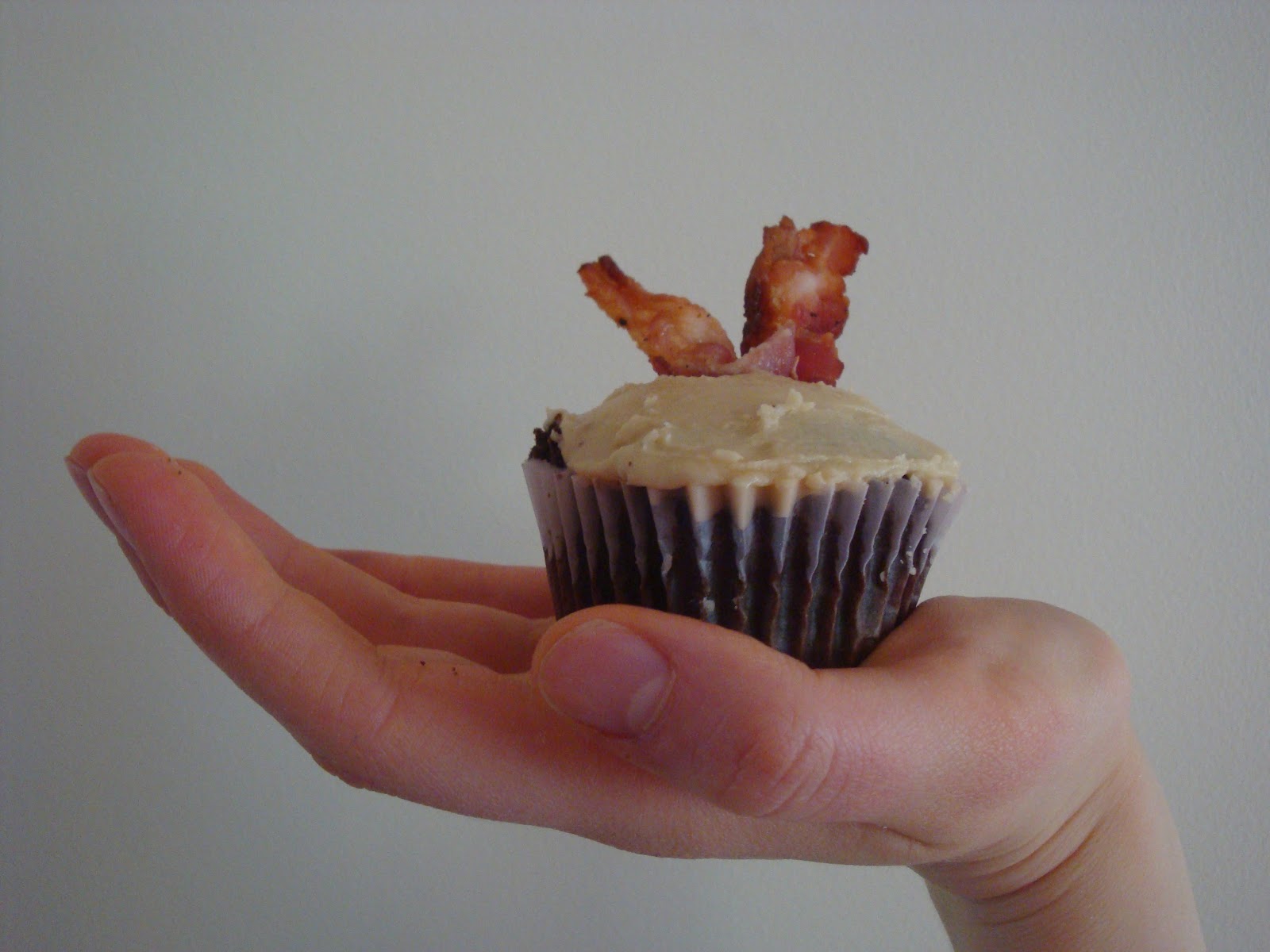
To be honest, I’m getting a little tired of the cupcake trend.  I’m really not interested in a tasteless sponge buried under a mound of superglycerinated paste.  I do however love bacon.  And chocolate.  And beer (obviously).  I set out to conquer my aversion to the world’s most annoying food trend by creating something so hedonistic even a hardened cynic like me can’t resist it.  This is a serious cupcake.  None of that piping bag bullshit.  Sweet, salty, smoky, bitter.

The rendered bacon fat adds an unusual smoky flavour to the cake, but the major flavour difference comes from the reduced stout.  Hence I would probably just use melted butter in the future.  I also resent how long I spent scrubbing bacon fat off the counter.  The cake recipe has no eggs, butter or milk in it.  Vegans will hate me for other reasons.

Bacon Chocolate Stout Cupcakes

Don't you want me, baby?
Cake
1 ½ cups all purpose flour
½ cup brown sugar
1/3 cup unsweetened cocoa
¼ cup granulated sugar
1 tsp baking soda
1 tsp vanilla extract
¼ tsp salt
6 tbsp melted butter or rendered bacon fat
1 tbsp apple cider vinegar
2 cups (500ml) stout beer
¾ cup dark chocolate chips (optional)

Frosting and Garnish
1 tbsp rendered bacon fat
2 tbsp butter
2 tbsp maple syrup
2 tbsp milk
½ tsp maple extract
¼ tsp salt
1 ½ cups icing sugar
6 strips cooked bacon, drained and cooled

  1. Preheat oven to 350°F.  Line a muffin pan with paper liners.
  2. Pour the stout into a medium saucepan.  Simmer over medium heat until reduced by half, then remove from heat and let cool.
  3. Sift dry ingredients (flour, sugar, cocoa, baking powder) together in large bowl.
  4. Make three depressions in the mound of dry ingredients.
  5. Pour melted butter (or bacon fat) in one depression, vanilla in another, and cider vinegar in the third.
  6. Pour cooled stout all over ingredients and stir until blended.
  7. Fold in chocolate chips if desired.
  8. Pour batter into lined pan and bake until a tester stick or toothpick inserted in the center comes out clean, about 20 minutes.
  9. Allow to cool 5 minutes before removing cake from pan by carefully lifting the parchment or cupcake liners.
  10.  Allow to cool for an additional fifteen minutes before icing.
  11. To make frosting, combine rendered bacon fat, butter, milk, salt, and maple syrup in a small mixing bowl.
  12. Gradually add icing sugar, mixing thoroughly to form a smooth paste.
  13. Feel free to adjust the milk and sugar volumes to attain the desired consistency.
  14. Frost the cooled cupcakes and garnish each with a piece of cooked bacon. 

Makes 16 cupcakes

Thursday, 9 February 2012

Drink it Pink

When I order beverages in restaurants and bars, I have a set of rules I abide by.
1. Nothing fluorescent.
2. Nothing that ends in or rhymes with “tini”
3. Nothing pink.

This eliminates most of the sugary cocktails and “girly” drinks, thereby maintaining my trivial sense of pride.  Rule #3 however is not without exception.

Case in point?  Dieu du Ciel’s Rosée d’Hibiscus, a bottle-fermented wheat beer infused with hibiscus flowers.  This adds a delicate floral aroma and a distinct acidity to the brew.

I’m also quite partial to the “Strawberry Angel” (aka. the “Dirty Ho”) served at the Pourhouse, Whyte Avenue.  Half Früli, half Hoegarden.  Try it - I dare you.

Valentine’s Day is fast approaching.  I myself am planning to spend it drinking chocolate stout and watching a predictable rom-com.  This may not be an appropriate game plan for persons with significant others.   Instead, advertise your domestic competence and impress your loved one by preparing a meal.  The pomegranate, with its four chambers and blood-red juice is a perfect representation of the heart.


Pomegranate Hibiscus Salad

5 oz. soft goat cheese log
½ cup finely chopped pecans, toasted and cooled
6 cups mesclun greens
½ cup pomegranate seeds (“arils”)
Freshly ground black pepper

Vinaigrette
1 tbsp pomegranate molasses
1 tsp Dijon mustard
⅓ cup hibiscus-infused wheat ale or chilled hibiscus tea
1 tsp fresh lemon zest
¼ cup canola or sunflower oil
  1. Combine ingredients for vinaigrette and whisk to emulsify.
  2. Combine greens, pomegranate seeds, and prepared vinaigrette.  Toss to coat with dressing.
  3. Roll goat cheese in pecans.
  4. Slice cheese into rounds.
  5. Top each salad with a round of pecan-crusted goat cheese and garnish with freshly ground black pepper.

Serves 4

Note: This vinaigrette can also be prepared with chilled hibiscus flower tea or a zesty Hefeweizen.

Thursday, 2 February 2012

Pilsner and Pizza

Pilsner Urquell is a beer of both historical and personal significance. I’m not sure if my weakness for free stuff instigated my fervent obsession with beer, or was merely the catalyst that set it in motion. Either way, I was a captive market after just one look at the elegant stemmed vessel in the liquor store flyer. Even after the addition of 70 subsequent glasses to my collection, this style has remained my favourite.


Pilsner Urquell is indeed the first of its kind, created in the Czech town of Plzensky Prazdroj. This town was once a part of the Austrian empire, and the name is translated from german to “Pilsner from the original source”. Josef Groll is thought to be the first to use a bottom-fermenting strain of yeast in 1842. Legend has it this particular strain of yeast was smuggled out of a monastery and given to Groll by a fugitive monk. The resulting brew was a clear golden hue - a stark contrast to the more prevalent cloudy top-fermenting beers.
Aren't they beautiful?  I have three...
The local ingredients - pale Moravian malt and Saaz hops, generate a clear, dry lager with medium body and a distinct bitter finish. This flavour profile makes pilsner a versatile style for pairing with food. The crisp pale malt does not overpower the delicate flavours of fish and seafood, while the refreshing hops can cut through rich fried foods. Think fish n’ chips, seared scallops, and – you guessed it, pizza.

Making pizza dough from scratch is a lot less work than it seems. The dough takes no time to mix up, and you can leave the dough to rise for several hours. Let the yeast do their business while you do yours.

Hint: If, like me, you exist in a realm of perpetual winter, your kitchen may be too cold for the yeast to ferment. You can turn your oven into a cosy little sauna by heating it to 200-250°F. Put the bowl of dough into the oven, shut the door, and turn the oven off. Just don’t forget it’s in there. 


Italian deli pizza with Capicolli, cremini mushrooms, and sundried tomatoes.
Pilsner Pizza Dough

3 cups unbleached flour (type 00 bread flour if possible)
1 cup durum wheat semolina*
1 ½ tbsp sugar
2 tsp instant yeast
1 tsp salt
3 tbsp olive oil
2 tbsp cornmeal
1 ½ cups (355ml) room-temperature beer

1. In a large mixing bowl, combine flour, semolina, sugar, yeast, and salt.
2. Gradually pour in beer and olive oil, mixing to form a dough.
3. Turn dough out onto floured surface and knead until smooth and elastic.
4. Form dough into a ball and place in a large, oiled bowl.
5. Cover bowl with a damp cloth and let rise until doubled in bulk. This will take about 1-1½ hours.
6. Punch dough down and let rise again, another hour or so.
7. Preheat oven to 350°F.
8. Sprinkle cornmeal over the bottom of two round baking sheets to prevent sticking.
9. Divide dough in half and shape each into a 10-12” round.
10. Stretch dough over baking sheet or transfer to pizza stone.
11. Add toppings and bake for 15-20 minutes.
12. Remove from oven and serve warm.

Makes 2 pizzas

*Semolina adds a nice flavour to the pizza, but can be substituted for all-purpose if not available

You can add whatever toppings you want. I’m an over-achiever, so I made three kinds.

Thai Chicken: Peanut sauce, chicken, red pepper, mango, green onion, mozzarella, and sesame seeds.

Barbecue Chicken: Barbecue sauce, caramelized onions, red pepper, chicken, and white cheddar.

Italian Deli: Tomato sauce, Capicolli, Cremini mushrooms, sundried tomatoes, and mozzarella.


Special thanks to guest photographer Eryn Thorsley.  All volunteers for this blog are compensated accordingly with food and/or beer.

Kenning, D. (2009) Beers of the World: Over 350 Classic Beers, Lagers, Ales, and Porters.

Thursday, 26 January 2012

Beer for Brunch

I think brunch could be my favourite meal of all time.  Especially at the end of a long week, or an eventful weekend.  Sunday is the perfect day to catch up with old friends, recount the previous night’s misadventures.  Brunch also seems to be the only situation where it’s perfectly acceptable to have dessert as a meal, and you can even have a beer before noon.  Today I’d like to recommend one of my favourite brunch spots, and to review a brew that pairs quite perfectly with bacon.  For that matter, what beer doesn’t go well with bacon?
Prairie Bistro on Urbanspoon
French toast with bacon, brie, and maple blueberry compote
I’ve worked at Prairie Bistro for the past eight months or so, and I have only recently taken a leave of absence.  It’s impossible for me to give an unbiased review of this place, so I’m not even going to try.  Located in the Enjoy Centre on the outskirts of St. Albert, the greenhouse setting is in line with the restaurant’s focus on local organic produce.  The prices are higher as a result, so if you’re looking for a $5 sandwich with mystery meat and Kraft singles, I’d suggest going somewhere else.  If you’d rather have a roasted chicken panini with smoked gouda on house baked bread, you’ll feel right at home.  The bistro offers both a cafeteria-style lunch service and an à la carte service all day.  And of course, Sunday brunch.

Each week I would work the brunch shift, eyeing my patrons enviously as they tore into Eggs Benedict with Gull Valley tomato bruschetta, brioche toast, and smoked bacon from Sandyview Farms.  The French toast special with brie held a certain appeal to me, and would be served differently each week depending on the ingredients in season.  I couldn’t have picked a better week to finally try it out.

What about the beer?  While the beer list at Prairie Bistro is small, they have taken explicit care to include only Canadian craft beers, with a lone Spanish sorghum malt selection for celiacs – nary a Molson in sight.

One beer is offered on tap as well: Yellowhead lager.  Edmonton’s newest microbrewery produces a lager that is really trying to be more like an ale.  Lagers are bottom-fermented at lower temperatures than the top-fermenting ales, and are known for having little sweetness and a crisp, sharp finish.  While Yellowhead is brewed as a lager using bottom-fermenting yeast, the light amber hue and the caramel sweetness suggest the flavour profile of an ale. To me, this is a good thing – ales tend to have more complex flavours as a result of esters formed during fermentation.  My one criticism is the lack of head retention, with little remaining two minutes after pouring.  Overall, the contrast of malty sweetness to the mild hop finish make it the perfect foil to both the sweet and savoury elements of brunch.

Thursday, 19 January 2012

Yeastie Boyz

One of my favorite things to do is gather up a few friends, zip up my parka, and drive over to Sherbrooke Liquor for some time in their beer fridge.  Their walk-in cooler is like a library, with countless bottles of various shapes, sizes, and colors line the shelves.  More often than not I will bring home a few large-bottle singles (650ml).  Not only are these beers sharable, but you aren’t stuck with five extra beers you may not enjoy.  No offence Alley Kat, but I’m really glad your Cringer Cranberry Ginger Ale was a one-time thing.

One of the first beers I discovered this way was Erdinger Weissbier.  A Weissbier or “Hefeweizen” (a fun word to say) , refer to varieties of beer brewed with 50-60% malted wheat, with malted barley making up the balance.  The varieties produced by Erdinger are bottle-fermented, which means the yeast is combined with the unfermented wort just before the bottling process.  The live yeast ferments the malt sugars to ethanol and carbon dioxide, producing a mature beer after 3-4 weeks of aging.  Darker varieties like Erdinger Dunkel use crystal malt too add body and a touch of caramel sweetness.

Bottle-conditioned beers deserve to be served in proper glassware.  A German-style weissbier should be served in a tall vase-shaped glass like the one designed by Erdinger.  These vessels have the capacity to hold an entire 650ml bottle, and showcase two inches of a meringue-like head.  This beautiful head will be ruined if you try and garnish the rim with a lemon or orange wedge, so save your fruit for breakfast.   Be sure to leave a finger’s width of beer in the bottle, swirling to re-suspend the yeast before pouring the rest.  Otherwise, the flavour of the live yeast will remain in the bottle as sediment, and you will miss out on a world of flavour.

With the exception of one or two products (La Bolduc, U Blonde, U Miel, and U Rousse), all beers produced by Unibroue undergo bottle fermentation.  Fin du Monde is a personal favorite, a fruity trippel with notes of spice and coriander, while its lower-alcohol sister  Blanche de Chambly is has a similar flavour profile.  Weizens are also unique for their use of Torulaspora delbrueckii, a particular yeast variety that produces  4-vinyl-guiacol as a fermentative product.  This compound provides the characteristic clove flavour, present in detectable levels (>1ppb) only in German and Belgian-style wheat beers.
The following recipe makes a tender beef roast with a rich mushroom gravy.  The same technique could be used to cook a pork roast with a lighter Weissbier.

Roast Beef with Mushroom-Weizen Gravy

 4 tbsp oil
8-10 shallots, thinly sliced
1 pint Cremini mushrooms
1 beef roast (g), trimmed of excess fat
1 tsp salt
Freshly ground black pepper
1 cup beef stock
1 tbsp fresh thyme leaves
1 bottle (650 ml) dark wheat ale (ie. Erdinger Dunkel or Noire de Chambly)
1 tbsp flour

  1. Combine roast and ale in a pan and marinate 3-4 hours or overnight.
  2. Preheat oven to 300°F with rack in middle position.
  3. Pat roast dry and rub evenly with salt and freshly ground black pepper, reserving marinade.
  4. Heat remaining oil in same dutch oven over high heat and brown roast on all sides.
  5. Add shallots, thyme, and ale marinade and bring to a simmer.
  6. Cover pot and transfer to oven.  Bake until tender (about 2 hours), turning roast over halfway through cooking.
  7. Transfer roast to a covered platter, covered and kept warm.
  8. Heat 2 tbsp oil in a dutch oven over medium heat.  Add shallots, mushrooms and a pinch salt.  Sauté until shallots are translucent and caramelized.  Remove from heat and set aside.
  9. Add juices to pan on stovetop over medium high heat.  Whisk in flour and bring to a boil.  Season to taste with salt and ground black pepper.
  10. Cook 1 minute, stirring nonstop.  Remove from heat and keep warm.
  11. Let roast rest 10-15 minutes before slicing.  Serve over crushed potatoes with warm sauce.
Mosher, R. (2009). Tasting Beer: An Insider's Guide to the World's Greatest Drink.
Cooking Light.com for image.

Thursday, 12 January 2012

Double Your Hoppiness

I love bitterness.  I take my coffee black, my chocolate dark, and my beer with as much hops as chemically possible.  Sometimes I bring extra hoppy beers to parties just so no one else will drink them.  Kidding!  But really, it’s a good strategy - beer misers take note!  But what are hops, exactly?  I’m going to take a moment to indulge my not-so-inner nerd, and impress you with some brewing chemistry.

Humulus lupulus, or “hops” (see left) has been a crucial ingredient in beer since the year 1000, but became popular in England in the 16th century. Hops is a plant that grows added to the mixture of malt, water and hops in the first step of brewing called the “wort”. The addition of hops to beer gives rise to bitter compounds called “alpha acids” (AAs) that provide a distinct flavour, and prevent spoilage.  Humulone (or lupulone) is the most abundant alpha acid, though it is converted to a more soluble form, isohumulone, in the brewing process.  Hop varieties with higher concentrations of AAs are used in the boiling of the wort for their antibacterial properties, thereby prolonging the shelf life of the beer.

India Pale Ale (IPA) is a very popular style of beer, said to have contained more hops in order to prevent spoilage during shipping by the East India Trading Company.  American pale ales tend to be stronger and hoppier than their British counterparts.  Bitterness can be measured in International Bitterness Units (IBUs), which are a function of the AA concentration.

Brewed with even more hops than an IPA and typically with a ABV above 7%, the Double IPA (DIPA) is not for the faint of heart.  Alley Kat has begun a series of DIPA each brewed with a different variety of hops. The Red Dragon DIPA was brewed only with Simcoe hops, .  This beer was fruity and slightly sweet with hints of orange zest and caramel to balance the high IBUs.  The Blue Dragon DIPA used Columbus hops, an aromatic variety commonly used in many American pale ales.  I’ve photographed this beer next to a small selection of glasses from my precious collection (I have a LOT more than shown).  I found this beer to be highly floral and pungent with a peppery bite.  A third variety, Green Dragon, will be released in February.  The brewery intends to release a new DIPA every 2 months.

The high bitterness of an IPA makes this style of beer the perfect accompaniment to spicy foods. Thai seafood curry, creole gumbo, or tandoori chicken are difficult to pair with wine, but are excellent with a hoppy IPA.  IPAs also pair extremely well with sharp cheeses, such as an extra old cheddar. 

Damodaran, S. (2008). Fennema’s Food Chemistry, Fourth Edition.
Mosher, R. (2009). Tasting Beer: An Insider’s Guide to the World’s Greatest Drink.
www.Botanical.com for image.